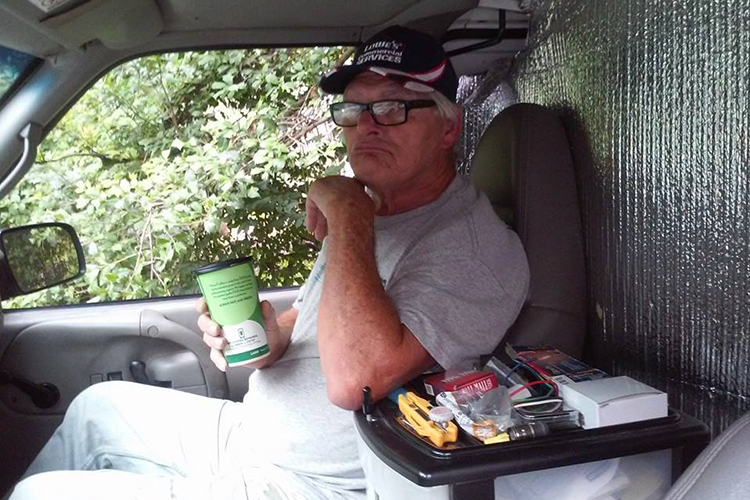
Like most people, every positive characteristic George Sadler had complimented another we could’ve all done without. But the most important realization I had regarding my father came to me when I was 16.
By then, I’d known people who didn’t have fathers. My best friend had a stepdad. His biological father was an asshole who only touched him to strike him. Others never knew their dads. All they had were voids into which they poured chemicals.
At 16, I accepted my father for who he was. It was the first of such lessons and for some reason I’ve had difficulty applying that lesson to virtually everybody else. I expected nothing from him and appreciated everything I received. For nearly twenty years, I loved him without expectation. And now that he’s gone, I only miss him.

We went to Disney World an awful lot when I was little, like many Florida families. My mother would convince my Grandpa to pay for us or we’d get tickets off my aunt, or the woman my uncle was dating, who worked inside a Mickey Mouse costume during Florida’s sweltering summers. We went often. My dad had the tendency to become irritable on family trips so they all included some type of blowout, so I’m sure this one was no exception. But I vividly remember a moment in the men’s room.
We walked in holding hands. I was old enough to use the regular sized urinals but young enough that I had to stand on my tiptoes to do so. I took the middle, normal-sized urinal, which left only the shorter one for him. In a bow-legged squat he laughed, joked, and in general made a fool of himself and peed in the short one. I laughed, I think. Either way, I thought it was funny.
As he squatted, and laughed, a man walked out behind us cowardly mumbling, “fucking idiot,” under his breath.
Even then, at maybe eight years old, I wanted to reach into Mickey’s mop closet, grab the step stool, place it next to this young man, step up, and throat-punch him.
I remember that it was the first time I had an instinct to protect my father. His humor seemed real to me, not a performance. I loved that I could be silly with him and that he would be silly back. Sure, he also called me a faggot, but that was his raising seeping into mine.
The single greatest gift my father gave me was the ability to act the fool. He was either foolish or angry. As a man, he taught me that it was okay to not always be hard. To cry. To laugh. And, most importantly, that it was okay to be foolish. There was no pride loss—no manhood at stake—if I put on a funny face, or a silly walk, or touched my nose with my tongue, especially if it made somebody laugh.
I was on a plane when he died, bound for St. Louis. It was late when we touched down. I had traveled for a roller derby tournament as a referee. I was excited about the event because I was invited the year before but only as an alternate. This time I was going to skate.
I couldn’t think.
When I spoke to my wife, I told her I needed a command. I needed somebody to tell me what to do because I could not imagine what the next step was.
I’d left my car at Tri-cities airport near Bristol. Half of the compound is a community college, the other side is a one-terminal airport that somehow flies the largest carriers in the country. My father’s body was in Tampa.
The only people I saw were passengers from my flight. By the time I got off the phone, I didn’t even see them anymore. I walked, half-crying, tired, and numb, searching for somebody with a Delta name tag. At a gate that wasn’t mine, a woman stood behind a monitor.
“M’am,” I said, voice trembling.
“Yes, honey?” she asked and looked up.
I saw her eyes shift from that false, customer-service sweetness to sincere concern.
I wasn’t crying, yet, but I was visibly upset.
“My father died while I was on the plane,” I admitted for the first time.
“Oh, honey, I’m sorry,” she said genuinely. “Do you need a hug?”
Some people are obviously mothers. I don’t mean they’ve given birth or even that they are women. Some people exude that particular brand of care, comfort, and accountability that is commonly associated with mothers. I knew she was a mom. And I needed one.
“Please,” I replied.
Her shoulders were soft and warm. She was shorter than me, but I felt like a child. It felt like the first hug of my life. We take hugs for granted like I love you‘s and birdsong–they mean very little until you really need one.
As my head fell on her shoulder, I cried for my dad.
I wanted to send her boss a message or mention her in a Yelp review:
My father died but this really nice stranger gave me a hug and told me it was going to be okay before breaking company protocol to ensure that I could get home to him and my grieving family for no extra charge. 5 stars!
It’s nearly impossible to make somebody feel better, even for a moment, after they’ve lost their parent, but she did.
I don’t remember the Uber ride to my hotel, the early morning wakeup, or the flight to St. Pete. I don’t even remember the details of the woman’s face. But I can still feel that hug when I think of my father’s death.

I was grateful for the obligations as a son. Without them, and traditional family responsibility, I would’ve been lost.
My family is nowhere near traditional. We were struggling long before my dad’s passing.
Still, the pageantry of regular families gave us something to do when we had not a clue otherwise. A son comforts his mother when she loses her spouse. He comforts his sister when her daddy’s gone. He makes the arrangements. He contacts family. He does all this and maybe, somehow, some time, he mourns his loss.
But his death highlighted our rotten core. It dug deep into the wound, poked around, and drew blood: it made things worse.
I know not to depend on my mother to be typical. But, you see, that’s kind of the problem. There is no typical mother. We do the best we can with what we have. Parents are no different, except that they want us to believe they are superheroes.
When my father died in front of her, gasping for air, it took whatever my mother had left of happiness. It just made it all worse.
Happiness never comes to you, anyway. It must be sought. And it never stays.
My father’s was a slow death, not unlike many Americans like him: a veteran, uneducated, and on the dole. Pharmaceutical drugs that turn you into an addict come easy and free if you’re like my parents. Food that nobody one hundred years ago would have recognized flowed into their house, paid for with tax dollars. It was just enough to prolong the inevitable.
In the fall of 2017, he spent a few weeks in the hospital where, in the end, they diagnosed him with Congestive Heart Failure and COPD. As a diabetic, he was especially susceptible to these conditions. As a smoker, it was guaranteed.
My family never called me while he was in the hospital. He was there for more than a week.
“We didn’t want to bother you,” my sister told me on the phone.
Aging and diabetes had made it difficult for him to always know when he had to piss. Often, he’d not make it. As he sat in his recliner with a small table beside it full of broken pairs of readers, various pocket knives with chunks missing from their blades, and a Penny Saver, the urge hit him. He jumped up and took off down the hall.
My mother and he had been fighting an upper respiratory infection. He had just received a new breathing treatment machine. He never got to use it.
He yelled for my mother. She found him in his room, his pants around his ankles, his piss-filled underwear lying on the floor. He’d changed but felt too weak to pull up his shorts. Mom was also too weak, so she told him to wait while she got a chair for him to lean on as he pulled them up.
She went into the kitchen to fetch the chair. As she turned, facing back toward his room, she saw him coming down the hallway, shorts around his ankles, with both hands bracing on the wall, in a wingspan.
“George! Wait until I get there with the cha…”
Before she finished her warning he collapsed. As any wife would, she ran to him.
His face was white, flooded with sweat, and he was trying to breathe. Thinking he had simply overheated, she put a fan on him. He shook his head no. He seemed like he was trying to say something. He sat against the footrest of his chair. She stood and tried to lift him by pulling under his arms. He’d never felt so heavy.
As she looked down at him, he put his head back, his eyes rolled, he exhaled, and slumped over.
Immediately, she tried CPR. She called 911. She did everything she could possibly do. She felt his ribs crack under the thrusts of her shaking, arthritic hands. She thought she’d hurt him, but he’d been gone. He was gone.
I know his brain was the last to go. He probably had some idea of what was happening. He was likely terrified. My father probably died during the scariest moment of his life.
He was almost certainly having a heart attack by the time he first tried to pull up his shorts.
Later, after looking through some notes from his doctor from a visit he’d had two days prior to his death, it was obvious he’d had warnings. His doctors knew and they did their best. There’s only so much we can do. We die, regardless of which pot you tithe into.
When I went to Florida, I was prepared to do what a son does. I came to be the dutiful one, to make arrangements, to comfort my mother, to encourage my sister. None of it really worked. I easily slipped into the trap of thinking I could fix this. In the end, I effected very little. We had no service, and he now sits in an urn painted with a fishing scene on my mother’s living room shelf.
I promised myself I would say goodbye and honor my dad.
Moving on despite what you’ve been through is a tough but freeing action. It’s like walking out of your burning house, mementos left behind in ash, and immediately saying, “I’m grateful.”
I’d accepted that I could’ve done more, and so could he.
There are millions of moments in life—most we waste. There are moments dedicated to shitting, scratching your balls, falling down drunk, and they’re all important in the process of becoming. We are a messy and fucked up lot. And our roughness—the smudged faces of us all—makes us interesting. There’s nothing more boring than a perfect person, and no such thing as a perfect life.
When my dad died, more than anything, I missed him. I wasn’t angry at the years he’d spent smoking cigarettes while his body produced less insulin, his arteries clogged, his heart swelled, parts of which had seized. I didn’t saddle my memory of him with the wish for a better daddy or even for one more moment. Memories of his smile crossed my mind, then his laugh, which I could never truly mimic, his bowed legs, wild eye, navel hernia, his smell, and sense of humor.
I’d learned what a man could be from my father’s failures.
My dad was one of those boomers who could be simply filed away as “of his generation” regarding how he treated women, people of color, my mother, my sister, and me. But that is horribly derisive and not entirely accurate. Like all things, it was more complicated.
My father’s façade was rough, handcrafted, and modeled from what he thought a man should be. His soul conflicted with that, and like many others, as he aged he allowed the heart to win more often. He loved much more openly by the time I was an adult than he ever allowed himself in my youth, but he was still an asshole, from time-to-time.
When he died, my mother struggled mostly with the fact that she rarely told him she loved him. It’s as if she’d lost the knowledge how. And once he was gone she immediately, and rather violently, wanted him back.
She had no idea how much he meant to her. She knew the bitterness, the resentment for years of abuse. She knew all the reasons why they never should have stayed together for the kids. She had never explored why she stayed for him. She never considered that she actually loved him. And without him she had no idea who she was.
There’s a reason why the English speaking world has a different title for somebody who loses a spouse.
I’ve been married long enough to the right person to feel my mother’s pain.
She had loved him despite her best efforts and enjoyed so little of their life together that all that was left was the pain.
The day after he passed, haunted by the image of him lying on the floor in front of that chair, the EMT’s doing whatever they could to bring him back, the sound of the cracking bones beneath her fists…she took whatever energy that pain, anger, and confusion had forged into her bones and dragged that chair out into the yard and burned it.
She would’ve done the same to all his belongings if we had not stopped her.
 Anthony Sadler
Beautifully written.
LikeLike
Mr. Sadler, words could never express to you just what your “Ruminations” have, and do, mean to me. I visit sometimes often. Other times, months have passed since reading. But, without fail, your prose induces an ache in my being. An ache of how beautiful an ugly world can be… is, when viewed from proper perspective. Thank you. Thank you for a gift given, of which you have been totally unaware. That is why I’m now, after so many years, leaving a comment. Such a ministry should never go unrecognized.
T.Coe
LikeLike