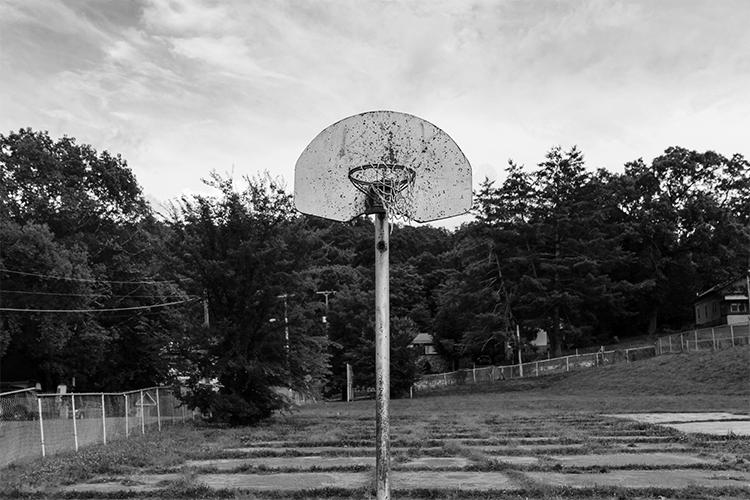
I once hit a kid in the face with a basketball because he called my mom a bitch. I was eight. It was instinct. Later, I cried.
Nowadays I’d never intentionally hurt somebody, certainly not for words, no matter how insulting. At my core, I’m not violent.
When anyone argues around me a knot forms in my gut. It tightens with each slur they hurl. It’s a curse dating back to my days in diapers dealing with folks who were constantly yelling. The knot developed early and contorted as I grew, getting tighter and more entrenched with the passing years. Today, my stomach hurts when I worry.
By the time I was in middle school the knot caused deep, disarming pain. I faked allergies so they would send me home. Bananas were the poison of choice. They were readily available at every school breakfast and, unlike oranges or apples, if my mother told me I couldn’t have them anymore, I wouldn’t miss them.
Doubling over and crying, I described my knot in great detail to the school nurse. “When did the pain start, Anthony,” she’d ask.
“After I ate the banana,” I replied.
I didn’t think it was lying because the pain was real.
My memories are bastards stumbling around my dome. Seemingly parentless, they don’t always make sense or know what they are. Some are vivid, varnishing scenes of great beauty and horror in marvelous detail. Others come to me as blurs, without context. The most confusing are the highly detailed moments that hang, suspended high above most others, without clues to their relevance and with blurry sections. I remember some of the names or words others used to make the knot tighten, but forget many details.
When I think of Miguel, a bully, I feel the knot as I did back then. I don’t remember his face. I don’t even remember what the school looked like; I couldn’t pick it out of a lineup let alone remember the details of the terrifying things I experienced there that make my 37-year old stomach hurt.

Miguel tortured me during P.E., an hour that provided a blend of anxiety and physical humiliation to most. West Tampa was the first school I went to that made us take showers. I hated showers at home and I certainly wasn’t about to step naked into a room with a dozen other boys under shower heads lining the walls. I wore a shirt and bathing suit instead, rubbing a bar of soap over my clothing, pretending it worked.
I have no idea how I compared to the other boys. I only know how I felt about myself. Who knows where the seed of insecurity lies? Some people can point to one moment or one person. For me, I’d always known my body was wrong. Every function it performed was inferior to original design. I just didn’t add up and I don’t know why.
What made this all worse was it was the one class I had with Allison. I thought we were the same because we both wore glasses, but we never spoke to each other. I was convinced she knew about Miguel and my wimpiness–convinced he was the reason she didn’t notice me.
He might have been small, but he was constantly surrounded by a group of boys. I always walked away and buried the fear, which I thought was noble. Really, I was scared and the fear, though hidden, never left. It swam around that head of mine, jumping through moments, painting the interior blue, making itself a home, where it enjoys the good life today.
Instead I’d dream of jumping on his back in the hallway and pummel him in the head, like I once did to my cousin Sean.
Sean and I always fought as kids. He’s well over six feet now and is three years older. He’s long; when we fought, he’d land several punches before I could run away.
Time and my size caught up to Sean.
He was once on my back. I was chest-down on the carpet, panicking. I reached up and grabbed the back of his shirt and somehow pulled him forward and over my head. His chest hit the carpet and he released me, but it was too late; a demon escaped.
I jumped on his back and chaotically punched. A dozen years of lost fights rushed out in a cloudburst of energy and rage that streamed through my spindly arms, forcing frequent blows upon the back of his head. At one point, I grabbed his hair and dragged the side of his face across the carpet, giving him a three-inch rug burn that lasted for weeks.
As I struck him I sobbed, like Ralphie in A Christmas Story
I never cried in front of Miguel.
He never kicked my ass, and I never kicked his. I think it had to do with my aversion to pain. Once I realized a punch in the nose might be coming, I cowered and took the verbal strikes, like nothing was happening. I imagine I was too pitiful to waste time beating on. For me, fear took the lead. What if he had a knife? What if the other boys joined in?
Each day after school, those of us who were bussed out would gather around the portable classes and wait for the yellow Bluebirds.
A girl named Jackie took to kicking me in the balls as we waited. She was taller than I and older, although we were in the same grade. At first, it started with her taking my candy money.
I ran an enterprise at West Tampa. I’d buy Mambas and Now and Laters, break them into individual pieces, and sell them for a quarter. Although I had no friends, I had many customers. Eventually I stopped selling the candy; the business turned belly up due to the loss of profits.
I don’t remember when she graduated to ball hitting, but her girlfriends told me she liked me–like really liked me. That’s why she hurt me.
All I knew was the knot tightened whenever she was around. I had no fantasy of beating her up. I had no fantasy about her at all.
I’ve yet to find another boy who had a girl bully. Maybe they just don’t want to admit it.
My father once told me, “never walk away from a fight.”
But when do you know you’re in a fight? I’d ask him if he were still alive.
And, what if a girl hurts you?
I think the pain and fear Jackie caused carried special significance in my mind–one attached to girls and how to show affection. Until then, I didn’t know girls could hurt me so bad.
I don’t remember the rest of my time at West Tampa. Or really much of my time in the next grade. I’m certain the knot remained. Maybe it stored the most sorrowful of my memories away, blurring the unnecessary sections, protecting me from danger. Maybe the knot is a gift, after all.
At Pierce Junior High I met Dave. He taught me how to dress in a way that might help fend off folks like Miguel and Jackie.
I never did drugs in school. I was too scared of what would happen to me. But, as my friends smoked in the bathroom, I was the lookout. The knot told me when to warn them.
Dave was one of the smokers. We met in some class on a day I can’t remember, but I do recall how we became friends. It involved a trade.
He was Miguel’s height, but looked meaner. He wore spike-studded belts, long chain-drive billfolds, and a mohawk dyed red. He played guitar. Outside of the movies and my uncle’s heavy metal album covers, I’d never seen anyone like him. He was the first of many “freaks” I’d call friends. Some of the best people in my life looked like Dave, maybe that’s why I remember him so well.
Naturally, Dave needed a spiked dog collar to wear. My mom worked at a pet store, so I could get one cheap.
In exchange I received Mellon Collie and the Infinite Sadness, a 90s post-grunge classic that my mother had banned because she hated the lyric, “cleanliness is godliness, and God is empty just like me.” When I sang it, the knot went away.
Dave seemed strong, sad, but like a kid that wouldn’t take shit from nobody. I felt that way because of how he dressed. As a kid in the middle of the worst bullying of my life, I envied him. He told me he’d teach me how to look like him.
“You have to shave your head,” he instructed.
I had a mullet I’d fought my mother for and wasn’t about to let go.
“You need Doc Martens.”
Around this time I’d discovered a new goal in life: to look like Eddie Vedder. The machismo, the anger, the long curly hair. I was there for it all. The corduroy jacket, tattered shorts, and wool socks rolled down to the top of a black pair of Doc Martens was a uniform I’d spend the next fifteen years trying to recreate. Singing with him made the knot disappear like nothing else.
The problem was those boots cost as much as my mom made in a week, and I didn’t have a job. If they weren’t showing up at Goodwill or Walmart they were out of the question. I settled for an off-brand pair that looked like what soldiers wore in the movies.
The rest of the uniform included dark t-shirts tucked into baggy pants, a long chain-drive wallet, piercings, which I was too much of a chicken shit to get. Instead, I drew dots on my ears so it looked like a stud of some sort. The coup de grace was red boot laces. It wasn’t just the color, but the way you tied them to look like the rungs of a ladder. We pulled them tight, connecting the two eyelets. My feet went numb the first time.
I wore the uniform to school almost every day, tripping over boots too big for my oversized feet.
At thirteen, I was five-foot eight with a size thirteen shoe. I was skinny, but also had a belly. I wore government-issued eye glasses and I styled the front of my mullet with LA Looks hair gel, aiming for the “all-rise” spiked look found in countless teen magazines of the mid-90s. I was well on the way to the self-discovery path I’m still treading, but so much more confused.
We had no gym at Pierce Junior High. We exercised on rough concrete basketball courts, or in the sand. The hot Florida sun inflamed my asthma.
In those days, schools issued P.E. shirts and shorts. We had to wear them, but could don any shoes we wanted. I’ve always been chunky, especially around my thighs, which caused my shorts to ride up. I wore the boots to P.E, in the heat, despite my asthma. What a rebel.
I ran, as we all did, but so much worse than the others. With my giant feet flopping about, it felt like running with skis on. I was typically the last kid to finish, which meant everybody had to wait on me before starting the next, more fun activity.
Years before, I developed a unique way of running to soften the abuse caused by coming in last. While everybody was watching, I put on a show. I’d run while swinging my arms like a swimmer. I looked like two windmills with their backs to each other. It was exhausting and made me slower, but they laughed.
At Pierce they didn’t.
“Daisy Dukes and Combat Boots!” one kid yelled, breaking through the sound of my boots thwapping the hot Florida sand.
I don’t even remember if it was boy or a girl.
I tried but failed to run faster, barely breathing but daring not to reach for my inhaler.
“Why don’t you hurry up so we can play ball before the sun sets, Daisy!”
From that day forward I was known as Daisy Dukes in Combat Boots.
When I stopped wearing the red shoelaces, Dave and I had very little left in common. Our temporary crew, the two of us, disbanded with little fanfare.
I had no idea why the outfit didn’t work.
I thought it was because my parents were poor, so I took to stomping my feet when they told me they couldn’t afford whatever ball player’s shoes were the hippest thing to wear at that time.
“But everybody’s gonna have the Griffey’s except me!”
I’d wail and refuse to wear what they could afford.
Dave’s status had nothing to do with the outfit. He was just better at acting like he didn’t care.
I smiled and talked too much to play the bad ass. I wanted people to know me and like me, so I brought attention to myself. I did what I still do. The difference is I care less now about what people think and I always make sure I have friends in the audience. I have people in the boat with me–those who care and let me care back.
At Pierce, I also met Amanda, an early boatmate.
Amanda saved me from more than she could ever possibly know.
Her chestnut hair floated in a way that kept my attention. People made fun of us because a boy and a girl walking home together wasn’t a common sight, unless one or both were gay or they were dating. We claimed to not like each other.
We just talked, and she liked me–like really liked me. I didn’t know it then, but I liked her too.
I’d pick little flowers for her as we walked and she’d talk about what it was like to be a girl without a mom or siblings. She’d press the flowers in her journal.
Nobody bothered me when I was with her.
I can clearly see her now at that age, walking beside me, smiling, giggling, well-lit by the sun.
“If you’re walking along the street with a girl,” my mom once taught me, “always make sure you’re on the side closest to the cars.”
“Why?” I asked.
“Because if a car runs off the road, it will hit you first,” she responded.
She explained it was chivalry, a word I couldn’t pronounce and neither she nor I knew the meaning of. She taught me that boy’s had to do certain things for girls they cared for.
I always kept Amanda to my right side. I thought I was saving her life. It was the only way I could tell her how I felt.
The knot tightened when we first started walking together. Over time, it eased off.
A few years went by and my family moved to Georgia.
We wrote to each other for a while. She sent me photos and letters written with dozens of ink colors. I’d write three sentences; she’d write six pages.
On one, she told me she loved me.
The knot tightened.
I thought I loved her, but I couldn’t write back.
The knot contorted further.
I remember Amanda well and I remember who I was. For years I kept her letters, I think to remind me, not of her, but of what I let go. For a long time, I wanted to do it all over again, but differently. I realized the pain of regret hurt more than getting kneed in the balls; I learned I could hurt myself worse than others could.
I now have no regrets regarding her, save one: I wish I had the guts to hold her hand as we walked.
 Anthony Sadler