Disasters, large and small, are only as damaging as we allow. Gone should be the days where the publicity surrounding calamities focus on the seemingly uncontrollable winds, rivers, and rains that kill and destroy. I do not speak of dams and other man-made pseudo scientific “cures” for the disasters. No, I criticize the very real and human decisions that cause the harm often associated with natural events.
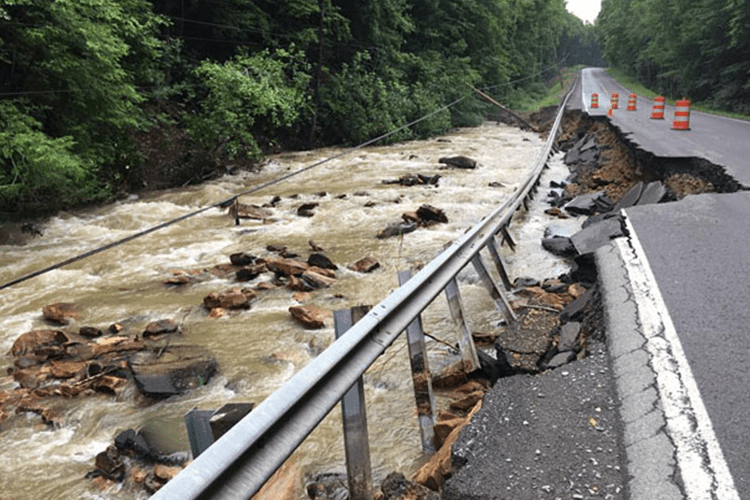
Two weeks ago more than a foot of rain fell on West Virginia, east of Charleston, in the area surrounding the Monagahela National Forest. Anybody aware of the delicate balance between slope and rain runoff in the Appalachian Mountains should understand the destruction such an inundation can cause. If the mountains were left alone–if their integrity withstood human colonization, urbanization, and resource extraction–this flood would have still happened. But the mountains are not the same.
The area surrounding ground zero of the disaster suffered the ills of modern excesses. Mountain Top removal built up the beds of rivers and streams. The scalping of peaks shortens the natural path of rainfall to the streams. The trees and topsoil removed in the process prevents the absorption of the runoff before it hits the waterways. The result is that the rainfall rushes faster and unhindered into the rivers of the valleys. Add to to that the ongoing cutting, paving, and widening involved with roadways and new construction. Each cubic yard of concrete that replaces natural soil and levels the curvature of Appalachian topography damages the region’s ability to handle downpours.
I argue that floods are much more than a whole lot of water. Disasters are much more complex than single day events. Inaccurate weather predictions aside, there are many, many moments leading to the “Big One’s” that indicate whether our society is capable of survival. Often, however, we either choose to ignore the warning or manipulate political, social, and economic systems to ensure that some suffer while others are safe. The latter method is simply spawned by greed.
Yes, money, too, causes natural disasters.
And the ones who want the most to bamboozle the majority of us are those who could really do the most good if they weren’t so goddamned “evil.”
Furthermore, organizations like FEMA mainly serve the general public’s need for a clear conscience. On one hand, we generally want to know that we will be taken care of in times of need, such as disasters. On the other, we do not want to sacrifice the sliver of our tax dollars that goes towards the government to protect us. This is especially true for those who have a distinct distaste for taxes and federal involvement. All is fine for anti-taxers who safely criticize while sitting on top of mountains.
But there was a time when the wealthy among us put their money and employees to work for the greater need, such as during the devastating floods of the summer of 1916. Those floods killed more than 150 people in the same area that was devastated in West Virginia. But the major issue with the involvement of big business in these affairs was their racist and elitist objectives.
All minorities suffer more during disasters due to intentional and systematic negligence. The decision about who benefits from any recovery attempts is almost always left to people of a different class and financial situation than those who lost everything, which was often not much to begin with.
Like then, the worst hit of this disaster are everybody small enough to live week-to-week, or day-to-day. This, because of a slop of socio-economic planning, includes the majority of West Virginia. It is false to ask why it is that a disaster in West Virginia damages so much and kills so many.
The right question is why does so many, with so little, live so near to that much danger?
And once the water subsides and the floating, enflamed houses disappear into an abyss of ash and mud, we should also ask why so little is actually done? Because long after the water returns to its banks and media vans head to the new “Top Story,” the people of West Virginia will remain in some of the most impoverished conditions in the nation.
Despite the devastating power of rivers at flood peak, regardless of the demolition caused by landslides, aside from the lingering smell of shit, kerosene, and pine, the disaster of West Virginia is social and economic.
Rivers simply have the good fortune of occasionally uncovering the messes we create.
 Anthony Sadler